John Embry has an article (a post) in kingworldnews. KWN does not permit the reprinting of their posts, so I will summarize the situation as I see it.
There is a war between the shorts in gold (bouillon banks, the so-called commercials) and swap dealers, and others.
Currently, there are really two markets in gold: 1. the physical market in actual metal and 2. a paper market of options to buy and sell. The last reliable report pegged the paper market as ten times the size of the physical market, but I do not know if this ratio still holds.
Large and savvy traders from everywhere had large orders to fill at 1,550 and around earlier in the year, so every time the gold fixing approached that level, orders were executed to fill. Gold supply, however, gets tighter and tighter.
We saw a mini rally in gold as shorts were covering around 1,700, which brought gold prices to 1,760-1,790. It is at this level that the PM wars continue.
What propels this war? The EU needs E2T to rescue its Southern members and the FED will print $1.2T to cover the deficit and maybe another $1T to "stimulate" the economy. The FED tries to cover up its sins by "sequestering" the newly digitized money, which makes it ineffective even by Keynesian standards, which would require the money to get into the economy. Thus, the FED is simply buying time, hoping the economy will eventually recover and take credit for the recovery.
The enormous amount of money created is still there though. All that money cheapens the currencies of the participants AND THAT IS WHY GOLD PRICES HAVE RISEN. This rise has been relatively slow because of the machinations of the anti-gold faction. We are coming to a time when the manipulators will fail to control the market and then...
Friday, October 12, 2012


The Case Against The Case Against Gold
October 11, 2012 In: Seeking Alpa.
By Dr Duru
Based on a quick web search, I noticed that many gold bears have written pieces with the same or similar titles. Clearly, there are common themes that embed this piece in a well-established tradition of hatred for gold. Seeking Alpha contributor Doug Eberhardt has also taken umbrage with this piece in his Instablog, and his rebuttal makes for a great read (he also posts the entire Zacks article). Eberhardt breaks things down in fine detail, point-by-point, adding lots of color. My response mainly focuses on noting how the gold bear arguments themselves demonstrate that gold is not nearly as different from other assets as the Zacks pieces suggests.
First of all, the title is a bit strange. It implies that the author thinks that markets do exist where a good case can be made for gold. In fact, the author notes that "historically, gold has been known as an effective store of value." I would have thought such a statement would end the entire debate. Instead of course there are caveats: "…but this has gone in and out of favor…The only thing that has intrinsically changed is the perception of what the future might bring." The last time I checked, bonds fall in and out of favor as well, with valuations fluctuating along with perceptions about the future. Secular and cyclical rallies, dips, and crashes are innate features of the markets we use to trade assets. Arguing that gold has a different degree of troughs and heights does not put it in a class alone. The rest of the article is full of these kinds of false differences (some repetitive). I use a problem vs. solution/comment format to highlight most of my remaining rebuttal.
Problem: "Typically, when people fear the causes of inflation, currency debasement or other potential economic downfalls, many feel it is a good time to invest in gold. Not me."
Comment: I specifically like gold as a hedge against the devaluation of the currency. The author's comments establish his position as anti-gold, but left me wondering whether this is a time when he would recommend buying gold.
Problem: "I don't see gold as a financial asset. Gold doesn't generate any income, and it doesn't pay a dividend. Thus I view it not as an investment but as a speculation."
Solution: For dividends, an investor can buy stock in a gold miner. My favorite gold miner, Goldcorp Inc. (GG), currently pays 1.2%. This may seem like trading 6 for a half dozen. However, if I look at Goldcorp's gold as simply a product that gets bought and sold according to the supplies and demands of the market, then fundamentalists can analyze it just as well as any company. Very few companies sell products that last for generations. Gold has outlasted civilizations.
Problem: "Gold's value completely depends on other people to act in a specific manner for it to go up in price."
Comment: People make markets. People must respond to bearish and bullish arguments to make any price move. Gold is no different. Stocks also depend on other people to act in a specific manner for it to go up in price. Other people must believe in the fundamentals, the technicals, and/or the theme to buy the stock. I see no difference between that and gold.
Problem: "Right now, countries around the world are trying to devalue their currency in order to improve exports and fight high unemployment. To some degree, real assets like gold should increase in price, but this idea is wholly dependent on people responding in a specific way to its inherent value, even when there's no fundamental reason to do so…The high price of gold is completely reliant on people's preferences. If those preferences change, the price of gold could fall dramatically."
Comment: This argument almost seems to contradict itself. This debasement has a potential impact on price levels throughout the economy, so it is enough of a fundamental reason to consider gold. Given gold's relatively fixed supply, its value in paper currency fundamentally increases with the amount of paper that spreads across the land. The author surprisingly admits that gold is "a real asset," but seems reluctant to accept that these debasements are a fundamental prop for price levels (including stocks!). Just like stocks, bonds, and land, people must respond in a specific way for value to get created: believe in the story of future earnings and cash flows, believe in the solvency of a company or country, believe that more and more people will find the location of your property attractive, etc. … If people's preferences for the multiples paid for earnings, for risk tolerances, or for location change, then, yes, even these assets will change in value.
Problem: "Gold is something you can hold in your hand and it looks very pretty. Buying gold is very much like buying an antique or an expensive piece of artwork."
Solution: As they say, "don't hate me because I'm beautiful." Buying gold is indeed like an antique or piece of art…except that no one uses those items as currency. The government can of course declare they have monetary value and enforce that value, but that is a flaw of any manufactured item trying to pass itself as currency, especially for pieces of paper. Gold requires no such permission. I think that gold's utility as jewelry is an added bonus to its appeal, not a detraction.
Problem: "My experience in investing has taught me that the asset class that is the hardest to own tends to perform the best. The one that's easiest, the one everyone is rushing towards, tends not to do as well."
Comment: Gold is NOT so easy to own, specifically because there are so many bears out there who are eager to see it crash. Central banks pretend to hate it even as they pile it up in reserves. The easy thing to own is paper currency. Our employers pay us with paper currency every day. With the S&P 500 at 5-year highs and bond prices at historic highs (yields at historic lows), are these assets easy to own now or hard to own? According to the logic of "anything that goes up must be too expensive," one might be tempted to dump stocks and bonds here…but of course that is not the advice given in this piece.
Problem: "The same way trees don't continually grow up into the sky, the price of gold will not continue to rise indefinitely."
Comment: This is a strange argument against gold when gold has indeed continued to rise over the long-term, generations even. I sure hope no one buys stocks and bonds because of a belief in their ability to rise indefinitely.
Problem: "Historically, when the price of gold crashes, it crashes fast."
Comment: Yes, exclude the modern day crashes in 1987, 1998, 2000, 2008, 2009, and stocks never crash fast. If gold ever crashes again, I will thank my lucky stars that I can grab it again so cheap. I sure did not buy enough back in 2008.
Problem: "In short, gold prices are being driven by 'animal spirits,' not any sort of evaluation of its intrinsic value."
Solution: If a notion of intrinsic value helps you sleep better at night, I suggest reading "Justifying Gold Prices From A Money Creation Perspective." It is a great reminder of why gold is "so high." The article also suggests, rightly so, that gold remains undervalued and under-appreciated.
Problem: "…recognize gold as something other than an investment - it is a speculation."
Response: Call it what you want, as long as gold is a store of value and a monetary unit, I am good with it.
Problem: "When everyone who has been parking their assets in gold decides it would be more productive to go into equities or other investments, the price of gold will reverse itself. Once people decide they want to stop buying the pretty rock, the price of gold will fall."
Response: This argument is a tautology. It even applies to bonds: 'When everyone who has been parking their assets in bonds decides it would more productive to go into equities or other investments, the price of bonds will reverse themselves.' Yet, even though this argument is true, no one would use it as a principle for avoiding bonds as an investment.
Problem: "What is driving the price of gold is not fundamentals, not income streams, but fluctuations and perceptions about expectations. It's essentially a speculation on mass psychology, and that, quite simply, cannot be predicted."
Response: Actually, the Federal Reserve has now made its printing rules very predictable, so I will be daring and predict gold will tend to go higher as this printing machine revs up. If the economy, GDP, stocks, and bonds were so predictable, we would all be millionaires by now.
I conclude by looking at the current setup for gold. The breakout from August 31st is well intact. While I did not interpret this year's Jackson Hole confab as a guarantee for QE3 in September, clearly a lot of people did. Gold was the first mover with stocks waiting a full week before experiencing its own breakout (to new 52-week and near 5-year highs). Just as stocks have stalled out at highs of the year, gold has stalled at its high for the year. I consider this point a rest stop for gold.
(click to enlarge)
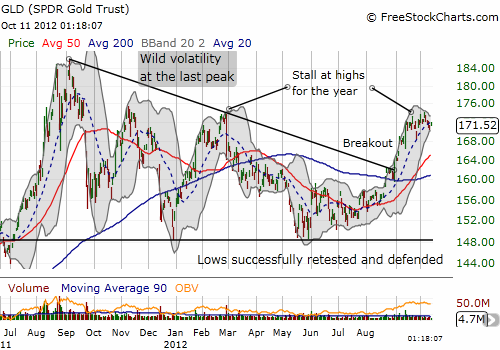
Gold's wild ride since the last peak
Source: FreeStockCharts.com
Thursday, October 11, 2012
A snapshot of the financial world.
1. Spain.
In the news again. That's not good since the Media likes to cover only bad news. It is the next installment of the soap opera: how bad is the situation and will Spain need a bailout? Answer: the recession is deepening and yes, maybe, Spain will need some help. For comic relief, check out the story on French-Spanish co-operation agreement just signed by the Spanish PM Rajoy and French President Hollande. I guess that PM Rajoy was hankering for some good French onion soup so he traveled to Paris to sign a perfectly useless agreement.
2. Gold.
There was an attack on the gold price last Friday. It was heralded by the short interest increasing from -16,000 contracts to +14,000. The move took gold to 1,760 or so. Today, the shorts are being covered and gold is moving above 1,770 again. The supply of actual gold is tight and getting tighter. Larry has still not given a buy signal.
3. The phony jobs report.
The FED told us that it takes 240K new jobs/month to maintain employment at an even keel. The September job number was 114K, lower than the August number, which was lower than the July number. Yet, the percent unemployed magically fell to 7.8% from 8.1%. The Obama regime trumpeted this as a great success; a proof that Obamanomics is finally working. The actual figure of unemployed and part time employment remains steady at 14%. There is no improvement in unemployment.
4. The QE saga.
Nothing new to report.
In the news again. That's not good since the Media likes to cover only bad news. It is the next installment of the soap opera: how bad is the situation and will Spain need a bailout? Answer: the recession is deepening and yes, maybe, Spain will need some help. For comic relief, check out the story on French-Spanish co-operation agreement just signed by the Spanish PM Rajoy and French President Hollande. I guess that PM Rajoy was hankering for some good French onion soup so he traveled to Paris to sign a perfectly useless agreement.
2. Gold.
There was an attack on the gold price last Friday. It was heralded by the short interest increasing from -16,000 contracts to +14,000. The move took gold to 1,760 or so. Today, the shorts are being covered and gold is moving above 1,770 again. The supply of actual gold is tight and getting tighter. Larry has still not given a buy signal.
3. The phony jobs report.
The FED told us that it takes 240K new jobs/month to maintain employment at an even keel. The September job number was 114K, lower than the August number, which was lower than the July number. Yet, the percent unemployed magically fell to 7.8% from 8.1%. The Obama regime trumpeted this as a great success; a proof that Obamanomics is finally working. The actual figure of unemployed and part time employment remains steady at 14%. There is no improvement in unemployment.
4. The QE saga.
Nothing new to report.
Thursday, October 4, 2012
What happened today?
We have learned the results of two meetings today: 1. the meeting at the top of the ECB and the meeting of the FED. The FED promised to keep interfering with the bond markets longer, while the ECB reiterated its willingness to keep the Euro afloat. So, how did the markets respond?
The Euro jumped and the US Dollar Index fell over 0.5. Gold that has been struggling with 1,790, closed above 1,790 and is now near 1,800. The mining shares? They did not do so well, making Larry look a bit better.
The Euro jumped and the US Dollar Index fell over 0.5. Gold that has been struggling with 1,790, closed above 1,790 and is now near 1,800. The mining shares? They did not do so well, making Larry look a bit better.
Tuesday, October 2, 2012
And here comes QE 4.
What, you haven't heard? I am not surprised. The MSM is busy with other things.
What is QE 4? QE 4 is a continuation of Operation Twist. Though QE 4 will resemble Operation Twist, it will be different, that is not identical to it. In Operation Twist, the FED bought long term Treasuries and sold short term Treasuries on its balance sheet. That is why it could be claimed that there was no additional money added to the Money Supply. In QE 4 the FED will simply buy $45B Treasuries/month, starting Jan 1, 2013.
So, the FED will be buying $45B/mo of Mortgage-backed Securities and $45b/mo Treasuries.
One more thing. QE 4 was announced by Charles Evans of Chicago, who will be part of the FOMC Committee next year. He is credited with being the author of QE3.
What is QE 4? QE 4 is a continuation of Operation Twist. Though QE 4 will resemble Operation Twist, it will be different, that is not identical to it. In Operation Twist, the FED bought long term Treasuries and sold short term Treasuries on its balance sheet. That is why it could be claimed that there was no additional money added to the Money Supply. In QE 4 the FED will simply buy $45B Treasuries/month, starting Jan 1, 2013.
So, the FED will be buying $45B/mo of Mortgage-backed Securities and $45b/mo Treasuries.
One more thing. QE 4 was announced by Charles Evans of Chicago, who will be part of the FOMC Committee next year. He is credited with being the author of QE3.
Monday, October 1, 2012
European soap opera: Today's chapter.
BARCGHART has a news section. It "explains" why stocks go up and down. It is hilarious. It claims that today's rise of stocks in the European markets are due to the fact that Traders are buoyed by the results of the Spanish banks stress test. Really? Assuming that we can trust the results (and do we remember how the Greek reports were -ahem- fabrications?) what are these results? Why, the Spanish banks are broke and need a loan of 70+ billion Dollars. Spain itself needs over $260B, assuming that the government survives the strikes, riots and regional clamoring to secede.
The abuse of seignorage.
Seignorage is the right of those in power to make a means of exchange. In olden times this meant the minting of coins. Kings and other rulers made a small profit on doing this. Most of the coins minted were made of gold, silver or platinum and copper. But, it was inconvenient and dangerous to carry large sums of money, so paper derivatives came into use. Paper derivatives represented sums of coin, deposited at some bank.
Seignorage changed when countries began to use the derivatives as money itself. Whereas kings had to mine silver and gold to mint coins(this fact acting to restrain the abuse of seignorage), paper is very cheap, so paper money could be printed cheaply and in large quantities.
The abuse of seignorage grew with the invention of creating money digitally then creating other derivatives. Modern derivatives seldom represent value of real things, they are in fact betting slips. Stock options are derivatives of stocks, the right to own a sale or a buy of a particular stock for a stated time. Options are paper assets. There are many other derivatives: contracts to own mortgages, betting slips on interest rates, currency, bond rates. These are all paper assets. It is estimated that the sum total of derivatives exceed the value of the underlying factors by ten. Thus, the contracts to buy silver or gold is ten times the amount of the metals that are actually sold and bought.
Kings abused seignorage by reducing the metal content of coins. The modern abuse of seignorage is far more prevalent and far more dangerous. The treatment of paper assets allows the makers of tradable derivatives to add to the money supply. This in fact is an abuse of seinorage. A far more prevalent abuse of seinorage is the printing (or digitizing) of paper money to cover deficit spending. Politicians provide "free" services to constituents and pay for it by printing money. Governments following inefficient economic models cover their sins by printing more money.
The whole world is awash in paper money and derivatives. It is a colossal abuse of seignorage. It will end with the destruction of paper currencies. How soon? Hard to tell. But, the failure of paper currencies will happen almost overnight as derivatives assume their true value: the value of the paper they are printed on.
We begin to see signs of this coming. Remember the "trade" one of our banks made on derivatives? It is said to have resulted in a loss of maybe $2B. Then the loss grew to $4B and now there are hints that the loss might be as large as $100B. Allegedly, the loss has to do with trades on derivatives of interest rates. But, interest rates aren't changing much. I can think of only one area where such losses could occur: selling contracts on gold and silver. Beginning last September, gold and silver prices went down as an avalanche of sale contracts flooded the market. Did the bank deal with options to deliver? I think so. And now, with gold and silver prices having risen, the liability is rising too.
Seignorage changed when countries began to use the derivatives as money itself. Whereas kings had to mine silver and gold to mint coins(this fact acting to restrain the abuse of seignorage), paper is very cheap, so paper money could be printed cheaply and in large quantities.
The abuse of seignorage grew with the invention of creating money digitally then creating other derivatives. Modern derivatives seldom represent value of real things, they are in fact betting slips. Stock options are derivatives of stocks, the right to own a sale or a buy of a particular stock for a stated time. Options are paper assets. There are many other derivatives: contracts to own mortgages, betting slips on interest rates, currency, bond rates. These are all paper assets. It is estimated that the sum total of derivatives exceed the value of the underlying factors by ten. Thus, the contracts to buy silver or gold is ten times the amount of the metals that are actually sold and bought.
Kings abused seignorage by reducing the metal content of coins. The modern abuse of seignorage is far more prevalent and far more dangerous. The treatment of paper assets allows the makers of tradable derivatives to add to the money supply. This in fact is an abuse of seinorage. A far more prevalent abuse of seinorage is the printing (or digitizing) of paper money to cover deficit spending. Politicians provide "free" services to constituents and pay for it by printing money. Governments following inefficient economic models cover their sins by printing more money.
The whole world is awash in paper money and derivatives. It is a colossal abuse of seignorage. It will end with the destruction of paper currencies. How soon? Hard to tell. But, the failure of paper currencies will happen almost overnight as derivatives assume their true value: the value of the paper they are printed on.
We begin to see signs of this coming. Remember the "trade" one of our banks made on derivatives? It is said to have resulted in a loss of maybe $2B. Then the loss grew to $4B and now there are hints that the loss might be as large as $100B. Allegedly, the loss has to do with trades on derivatives of interest rates. But, interest rates aren't changing much. I can think of only one area where such losses could occur: selling contracts on gold and silver. Beginning last September, gold and silver prices went down as an avalanche of sale contracts flooded the market. Did the bank deal with options to deliver? I think so. And now, with gold and silver prices having risen, the liability is rising too.
Subscribe to:
Posts (Atom)
